
Family cycling routes in Brandenburg
From the Klenzegen journal in Hoppegarten — written for riders who want clear, usable detail.
Brandenburg is close to ideal for family cycling and slightly awkward at the same time. The terrain is flat, the forest is everywhere, and the long-distance path network is genuinely good. What it lacks is obvious: shade on hot days, and reliable surfaces once you leave the marked routes. Sand is the difference between a pleasant afternoon and a two-hour argument.
This post covers how to plan a family ride around Hoppegarten and the Berlin fringe so that the route works for the least experienced rider in the group.
Plan around the slowest rider, not the distance
The instinct is to pick a distance. The better approach is to pick a duration and a turnaround point. Children ride happily until they stop suddenly, and the failure mode is always the return leg.
Rough planning figures that hold up in practice: a confident seven-year-old manages 10 to 15 kilometres in a session with breaks; a ten-year-old handles 20 to 25 without much drama; a child on a trailer bike or in a cargo box has no distance limit but a real patience limit. Always plan the route so you can shorten it — a station, a bus stop or a shortcut back — rather than committing to a loop.
- Set a time budget, then design a route inside it.
- Put the food stop at roughly one third of the ride, not halfway.
- Ride into any headwind on the way out.
- Know your escape options before you set off.
What makes a route family-friendly here
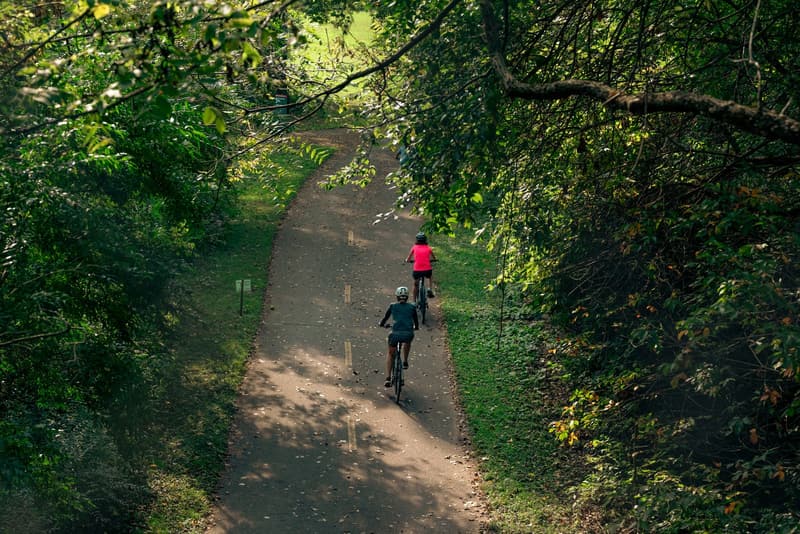
Four things matter more than scenery: a hard surface, separation from motor traffic, a destination worth reaching, and shade. Brandenburg delivers the first two on marked routes and the fourth inconsistently, since pine plantations cast surprisingly little shade in the middle of the day.
Surface deserves special attention. Many attractive-looking forest paths are deep, loose sand. An adult on 42 mm tires rides through it; a child on 20-inch wheels does not. Where a route description says "unpaved", assume sand until proven otherwise, and check satellite imagery for the pale strips that give it away.
Route types that work from the eastern edge of Berlin
| Route type | Why it works | Watch for |
|---|---|---|
| Lakeside loops | Flat, a swimming stop as the destination, cafés nearby | Busy at weekends; some paths shared with walkers |
| Canal and river towpaths | Gentle, continuous, no junctions to negotiate | Surface varies; little shade |
| Marked long-distance Radwege | Signposted, mostly sealed, well mapped | Can run alongside busier roads in sections |
| Forest cycle paths | Shade, quiet, wildlife | Sand and roots; check the surface first |
| Train-assisted point to point | One-way riding, no return leg to survive | Bike tickets and space at peak times |
The last one is the most useful trick available to families near Berlin. Regional trains carry bicycles in marked carriages, so you can ride outward in one direction and take the train home. It removes the return-leg problem entirely, which is the single biggest cause of unhappy family rides. Our post on German cycle infrastructure explains how the bike-and-train combination works in practice.
Riding as a group with children
A predictable formation matters more than speed. The usual arrangement puts the most confident adult at the back, where they can see everything, and a child who knows the route at the front. Children ride in the middle. Announce hazards out loud and early — gravel, walker, car — because children react to instructions far better than to a bell they cannot interpret.
At junctions, adopt one rule and never bend it: nobody crosses until an adult says so. Consistency is what makes it safe, not the specific rule.
The point of a family ride is that everyone wants to do it again next weekend.
What to carry
More water than seems necessary, because shade is unreliable and children dehydrate faster than adults notice. Real food rather than gels. A basic first aid kit. Sunscreen. One pump and one spare tube for each wheel size in the group — a 20-inch tube is useless for a 28-inch wheel. And a small toolkit, since children's bikes tend to develop loose bolts and rubbing brakes rather than dramatic failures. Our maintenance basics post covers the pre-ride check worth doing on every bike in the group.
Carrying the youngest riders
For children too small to ride independently, the options are a child seat, a trailer, a trailer bike or a cargo bike. Child seats are simple and cheap but change the handling of the bike noticeably. Trailers are stable, weatherproof and low to the ground. Trailer bikes let an older child contribute and are a good bridge to independence. Cargo bikes carry two children with luggage and have become the standard German answer for exactly this — our cargo bike post compares the formats.
Weather and season
Late spring and early autumn are the best windows: firmer sand, fewer insects, comfortable temperatures. Midsummer afternoons in open Brandenburg are hotter than the forest suggests, so start early and plan a water stop. Winter family riding works for short local loops, but the daylight window is narrow — see our winter cycling post for lighting and clothing.
Frequently asked questions
How far can a child ride in one day?
As a rough guide, a confident seven-year-old manages 10 to 15 kilometres with breaks, and a ten-year-old 20 to 25. Plan around a time budget rather than a distance, and always keep a shortcut or a station as an escape route for the return leg.
Are Brandenburg forest paths suitable for children's bikes?
Often not. Many look inviting but are deep, loose sand that small wheels cannot ride through. Prefer marked and mostly sealed routes, canal towpaths and lakeside loops, and check satellite imagery for pale sandy strips before committing to a forest section.
Can we take children's bikes on the train near Berlin?
Yes. Regional and S-Bahn services have marked bicycle carriages and normally require a separate bike ticket. Riding out and taking the train home removes the return leg, which is the most common reason family rides go wrong.
What is the best way to carry a toddler by bike?
A child seat is simplest for short trips, a trailer is stable and weatherproof, and a cargo bike carries two children plus luggage. A trailer bike suits older children who can contribute pedalling but are not ready to ride independently in traffic.
How should a family group ride be organised on a path?
Put the most confident adult at the back with a clear view of everyone and a child who knows the route at the front, with the rest in the middle. Call out hazards early and apply one consistent rule at junctions: nobody crosses until an adult says so.