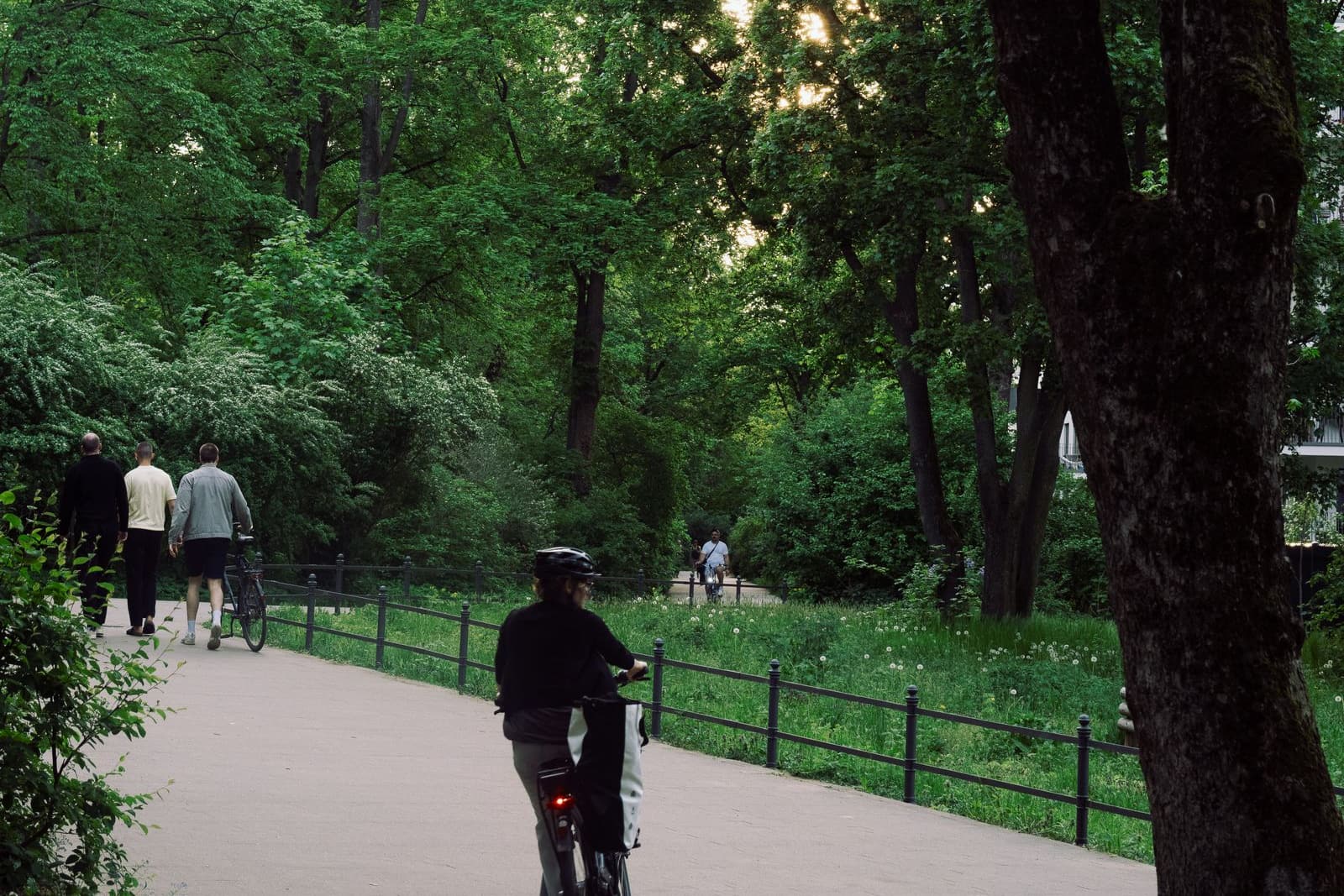
Why German bike lanes feel different
From the Klenzegen journal in Hoppegarten — written for riders who want clear, usable detail.
Riders arriving from countries with thinner cycling infrastructure often describe the same first impression of Germany: there is a lot of it, and it does not always behave the way they expect. The lanes are numerous, the signage is dense, and the social rules around them are stricter than the paint suggests.
This is a practical orientation to how German cycle infrastructure is built, what the signs mean, and which habits keep you out of conflict with drivers, pedestrians and other cyclists.
Three kinds of cycle path, one word
English tends to flatten everything into “bike lane”. German infrastructure distinguishes several types, and the distinction changes your obligations.
- Radweg — a physically separated path, often behind a kerb or on the pavement level, sometimes marked with a blue round sign.
- Schutzstreifen — an advisory lane on the carriageway, marked with a broken line. Cars may cross it when necessary.
- Radfahrstreifen — a mandatory lane on the carriageway, marked with a solid line. Motor traffic must stay out of it.
The visual difference is a line style; the legal difference is real. A broken line means you share space under pressure. A solid line means the space is yours. Reading which one you are on before a junction is a habit worth building early.
The blue sign does more than decorate
A round blue sign with a white bicycle marks a path you are generally required to use. An unsigned path next to the road is usually optional — you may legally ride on the carriageway instead. Many visitors assume every path is compulsory and end up on a narrow, root-damaged pavement path when the smooth road beside it was permitted.
Where a path is shared with pedestrians, the sign shows both symbols. If the symbols sit side by side with a dividing line, the space is split and you stay on your half. If they are stacked without a divider, it is genuinely shared space and walking pace behaviour is expected when people are around.
Junctions are where the design gets tested
Straight sections of German cycle path are usually pleasant. Junctions are where infrastructure quality becomes visible, and where most conflicts happen. Older designs sweep the cycle path away from the carriageway before an intersection, which reduces your visibility to a driver turning right at exactly the moment it matters most.
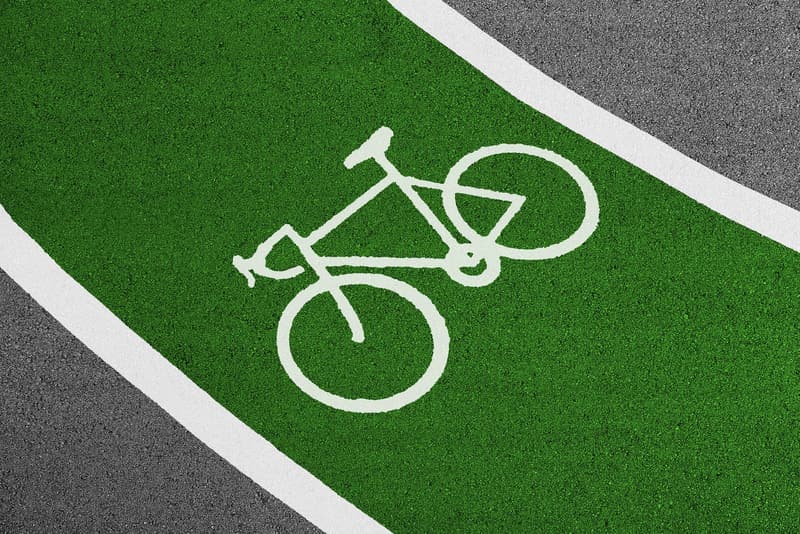
Newer redesigns pull the path back toward the road, raise it across the side street and use colour to mark the conflict zone. Cities including Berlin have been converting junctions steadily, but the older geometry is still common, so the defensive habit remains useful: assume a turning driver has not seen you, and make eye contact before you commit.
Good infrastructure lowers the cost of a mistake. It does not remove the need to look.
Right of way rules that surprise people
Two rules catch newcomers regularly. First, when a cycle path runs alongside a priority road and crosses a side street, cyclists usually keep the priority of that road — but drivers do not always behave as if that is true. Second, cyclists coming out of a driveway, a parking area or a footway crossing give way, even when they are on a marked surface.
The practical version: treat priority as something you confirm, not something you assume. Cover the brakes at side streets, and look for the front wheel of a waiting car — it moves before the driver's head does.
Equipment expectations are enforced
German traffic rules are specific about bicycle equipment, and enforcement is not theoretical. Working front and rear lights, reflectors, two independent brakes and a bell are the baseline. Riding without lights after dark is the single most common reason riders get stopped.
Dynamo lighting is the local norm for exactly this reason: it removes the failure mode of a flat battery. On a bike used through the dark half of the year, a hub dynamo pays for itself in avoided hassle. Our winter riding guide covers the rest of the dark-season setup, and the helmet and safety post covers what the rules do and do not require.
Fahrradstraßen and the one-way exception
Two designs deserve their own mention because they behave differently from anything a newcomer will have used before.
A Fahrradstraße is a street where bicycles are the priority traffic. Motor vehicles may be permitted by an additional sign, usually for residents, but they are guests: they must not overtake in a way that obstructs cycles, and riders may legally ride two abreast. These streets are the backbone of several Berlin districts, and they only work because the priority is genuinely respected. Ride them confidently and in the middle of the lane rather than hugging the parked cars.
The second is the one-way street that is open to cycles in both directions, marked by a small supplementary sign showing a bicycle with a counter-arrow. This is common in residential areas and startles drivers less than it startles visiting cyclists, who often assume the sign cannot mean what it says. It does. Ride it, but expect a driver emerging from a parking space to look only one way.
Where the surface quality actually varies
The map shows a continuous network; the reality is a patchwork with three distinct tiers. Recently built protected lanes and rebuilt Radwege are smooth and generous. Older pavement-level paths, often laid in small paving stones under mature trees, are narrow and root-damaged — legally usable, practically slower than the road beside them. And rural Radwege alongside Landstraßen vary from excellent asphalt to compacted gravel within a single stretch.
That variation is the main reason so many German everyday bikes run wide tires and mudguards rather than narrow, fast rubber. It is also why testing a commute at a quiet hour before committing to it is worth more than any route planner: the gradient is not the variable here, the surface is.
Unwritten etiquette
Formal rules are only half of the experience. The social layer is what makes German paths feel orderly to some visitors and rigid to others.
- Signal turns clearly with an outstretched arm; drivers and other riders actually watch for it.
- Ring the bell before overtaking on a shared path, then pass wide and slowly.
- Do not stop in the lane. Step off it, the way you would step off a road.
- Keep right when riding slowly. Faster riders will pass on the left and expect predictability.
- Expect to be corrected. Being told off by a stranger for riding the wrong way is a normal, if unwelcome, part of the culture.
Mixing bikes with trains
The network extends beyond the paths themselves. Regional trains around Berlin and Brandenburg carry bicycles in marked carriages, usually with a separate bike ticket, and outside peak hours the space is genuinely usable. That combination is what makes long one-way routes practical: ride out, take the train home.
Folding bikes travel as luggage and skip the bike ticket entirely, which is why they are disproportionately common among commuters who combine cycling with rail. For the wider picture of how this system fits together, see our overview of cycling in Germany.
What to do in the first week
If you have just moved here, three habits will smooth the transition faster than reading the full traffic code. Learn to distinguish a solid from a broken lane line at a glance. Fit lights that are always on the bike. And ride a few routes at off-peak times before you commit to them as a commute — path quality varies street by street, and the map will not tell you where the surface is broken.
Frequently asked questions
Do I always have to use the cycle path in Germany?
Only where the path is marked with the round blue bicycle sign, which makes use compulsory. An unsigned path beside the road is optional, and you may ride on the carriageway instead — which is often the better choice when the path surface is poor.
What is the difference between a Schutzstreifen and a Radfahrstreifen?
A Schutzstreifen is an advisory lane marked with a broken line, and motor vehicles may cross it when the situation requires. A Radfahrstreifen is marked with a solid line and is reserved for cycles, so motor traffic must stay out of it.
Are bicycle lights legally required?
Yes. A working front and rear light plus reflectors are mandatory when visibility is poor or after dark, and riding without them is the most common reason cyclists are stopped. Hub dynamo lighting is popular locally because it removes the risk of a dead battery.
Can I ride two abreast on a German cycle path?
Riding side by side is permitted where it does not obstruct other traffic, so it works on wide paths and quiet routes but not on narrow lanes at busy times. In practice, single file with quick regrouping is the courteous default in traffic.
Can I take a bicycle on a train around Berlin?
Yes. Regional and S-Bahn services have marked bicycle carriages and normally require a separate bike ticket, with space easiest to find outside peak commuting hours. Folding bikes count as luggage and need no extra ticket.